

Exploratory Committee

A testing the waters organization has announced the formation of the Harold E. Ford, Jr. Presidential Exploratory Committee to determine the viability of a centrist to restore America’s body politic, revive the electorate’s faith in government, and revitalize the concept of federalism outlined by the Founding Fathers.

Harold E. Ford, Jr. is a former Representative from Tennessee. He was elected as a Democrat to Congress in 1997 and served four succeeding terms as a member of the 105th, 106th, 107th, 108th and 109th Congressional classes.

This is an independent, grass roots effort and is not affiliated in any capacity with a formal political action committee promoting the candidacy of Harold E. Ford, Jr. and is not authorized by Harold E. Ford, Jr.

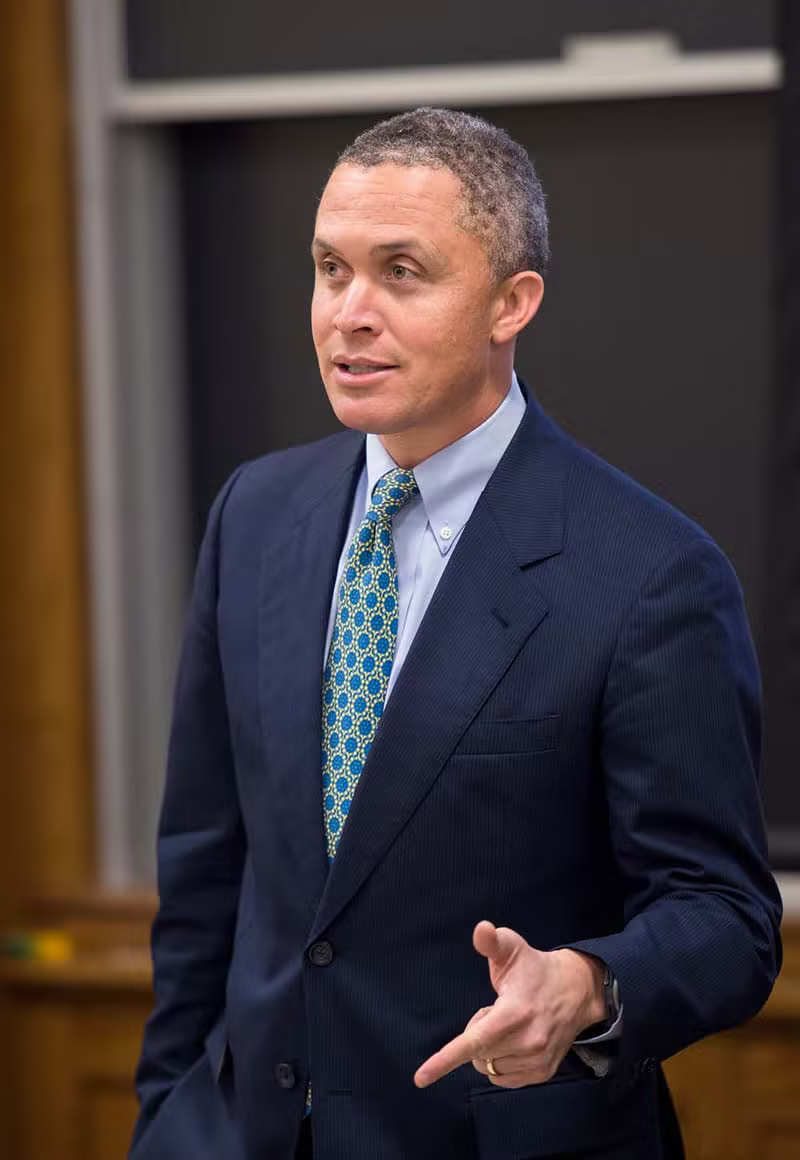
Harold E. Ford, Jr. addressing a crowd

University of Michigan photo

The State of Our Union

America stands at a historical juncture. For decades decision makers in Washington have bickered their way to paralyzing our government. Folks are feeling disheartened by a combination of severe economic pressures, pervasive effects of social media, and anxiety about the future. Many are facing declining happiness and reporting high levels of anxiety.

Young people feel they are facing a much steeper climb to financial independence than previous generations, with high housing costs and inflation leading to sensations of being left behind. They believe the system no longer rewards long-term planning resulting in survival strategies and, ultimately, giving up on traditional financial goals. Furthermore, the relentless fast-paced nature of online news and algorithm-driven content fosters a sense of insecurity and, in some cases, a new norm of hopeless sentiment. Finally, a general sense of dread regarding political polarization, social unrest, and safety creates a backdrop of chronic, low-level stress.

Since 2009, presidential administrations have issued no less than 858 Executive Orders. Issued under the president's constitutional or statutory authority, these orders have the force of law without congressional approval, typically directing executive agencies on how to implement legislation. What was intended to help manage operations of the federal government has been transformed into political chicanery. The lack of action by Congress to fulfill its constitutional obligations has devolved into a legislative void or abyss between the opposing realms of both Republican and Democrat parties. After 17 years of constitutional dysfunction, there is little wonder why Americans, particularly our younger generations, feel despondent with many demanding the demise of what initially made the United States of America the embodiment of freedom, justice, and economic opportunity.

To get America moving again we must maintain a strong national defense, accelerate economic growth for all, and correct the integral disparities that federal programs were originally intended to address. We must overcome post-Covid challenges by fostering social progress, technological advancement, and public service. It is also time for unity and equality to resolve the systemic failures that leave citizens marginalized. Economic growth and productivity can be achieved through national reconciliation—building trust, accepting responsibility, and reconciling differences to ensure that the next generation of Americans is better off than the last. Ultimately, it is ‘we the people’ that must act to seek those with political experience, fortitude, and will to set us on a fruitful path.

Harold E. Ford, Jr. on the sense of duty

“Voters expect from politicians a certain level of disagreement in discourse and passion as politicians debate robustly and, hopefully, honestly the issues of the day. But what we have today, unfortunately, is not necessarily a lack of civility, we just have a lack of attention to the most pressing issues facing the country. There’s always a lack of civility in politics and I chalk that up as people being passionate, but we have a lack of results and right now our whole body politic is broken.” (The Detroiter).

Harold E. Ford, Jr. on the sense of unity

“It just takes leadership and I think the country is hungry for it and would embrace leaders that were not so far on each side. The majority of the country is right in the middle, but a lot of people going into government don’t understand how government operates. They think you go into government to impose your ideas on people because your ideas are superior. That’s not how government works. That’s not how the country started. Our country is built on a canyon of compromises.” (The Detroiter).

Harold E. Ford, Jr. on resolution

“Voters need to elect better people and you need better people to seek office who are more concerned about making the country function than they are just scoring cheap political points or advancing themselves. And we should define what being good at politics means. It means solving problems. You must work with people, and you need to work with people in your party and people outside your party. We lack that right now.” (The Detroiter).

Who Is Harold E. Ford, Jr.?

A Brief history

Harold E. Ford, Jr., is a former Representative from Tennessee. He was born in Memphis, Shelby County, Tennessee on May 11, 1970. He was the eldest son of Harold Eugene and Dorothy Bowles Ford. His father was a member of the Tennessee state legislature who won election to the U.S. House when Ford, Jr., was four years old and went on to serve for more than two decades. His mother was a longtime employee of the U.S. Department of Agriculture. After graduating from St. Albans School for Boys in Washington, D.C., Ford, Jr., obtained a B.A. from the University of Pennsylvania and then a law degree from the University of Michigan Law School in 1996. He was elected as a Democrat to Congress in 1997 and served four succeeding terms as a member of the 105th, 106th, 107th, 108th and 109th Congressional classes. He was the first African American lawmaker to succeed a parent in Congress.

After leaving the U.S. House in January 2007, Ford, Jr., served as a visiting professor at Vanderbilt University and the Lyndon B. Johnson School of Public Affairs at the University of Texas–Austin. He also succeeded Iowa Governor Tom Vilsack as chair of the Democratic Leadership Council, an organization that fostered a centrist approach to economic policy and politics. In 2008, he married Emily Threlkeld; the couple have two children: Georgia and Harold III. Ford, Jr., moved to New York City where he worked in the financial services industry and as a political commentator on television.

Shortly after he entered Congress, Ford, Jr., was chosen by his Democratic colleagues as freshman class president, making him the spokesperson for the newly elected Members and an intermediary with House leaders. In his first term, Ford, Jr., received committee assignments on Education and the Workforce and Government Reform and Oversight. He left the latter committee in the 107th Congress (2001–2003) to accept a seat on the Financial Services Committee. In the following Congress, Ford, Jr., won a seat on the influential Budget Committee.

Ford, Jr., not only worked to direct federal resources to Americans living in poverty, he also emphasized different policies to fight poverty, such as expanding educational opportunities. Ford, Jr., emphasized political pragmatism and the need to work together with state and local entities. Memphis city hall, he observed, is “the principal contracting agency with the federal government. I have a responsibility to secure what funds and resources I can for my state and city.”

During his career, Ford, Jr., sponsored measures to reform the country’s campaign finance system, equitably fund education, and support troops and veterans. Ford, Jr., supported balancing the federal budget and frequently denounced spending that raised the national debt, particularly during the presidency of George W. Bush. In 2005, he bemoaned the Republican budget resolution and criticized its proposed spending. “I would be embarrassed if I had to vote for this budget,” he said. “Thankfully I do not, and frankly I do not even know if I am going to vote for all the things we are going to present on our side, for one reason. It is not balanced.”

Ford, Jr., worked to attract voters from across the political spectrum, campaigning on everyday issues including health care, education, and economic development. Ford, Jr., often carved out independent positions and took policy stances different from those of his fellow House Democrats. “Ideology,” he once lamented, “makes it easier to resist good ideas.” Ford, Jr., supported Democratic causes such as environmental protection and affirmative action, but he also backed measures that many in his party opposed, including private school vouchers, prayer in schools, and federal funding for faith-based charities. Ford, Jr., made it a point to work with Republicans and supported GOP initiatives to privatize Social Security. He voted for the USA PATRIOT Act in 2001 following the terrorist attacks of September 11 and the 2003 Partial-Birth Abortion Act.

The legacy of Harold E. Ford, Jr., in political affairs embodies diverse—rather than divergent—principles. He represents a political plurality whose voice has been diminished, if not demonized, by special interests on both extremes of the political spectrum.

Where He Stands

The Hard Choices

Fiscal Responsibility
The appearance of U.S. Department of War (DoW) visual information does not imply or constitute DoW endorsement.

During his decade in Congress, Harold Ford Jr. earned a reputation for working across the political aisle to find common ground. He served as a member of the Blue Dog coalition, an official caucus in the U.S. House of Representatives comprised of fiscally responsible Democrats. While frustrated with the current political moment and concerned about the message it may send to the next generation of elected officials, Ford remains optimistic about the country’s ability to return to a functional government built around compromise. Martinez, J. (2022, June 15). Long on America. Detroit Magazine. https://www.detroitchamber.com/long-on-america-2/.

Special note: the term ‘Blue Dogs’ was coined in 1995 by conservative Democrats who felt they were being “choked blue” by the extremes of both political parties after significant electoral defeats. Blue Dogs advocate budgeting, reducing the national debt, and policies that require any new federal spending be offset by budget cuts or increased revenue to avoid increasing the deficit, making them pragmatic centrists who frequently push back against more liberal policies.

Personal Liberty: His congressional voting record shows he has supported abortion rights and also has supported restrictions on them. “To say that I am pro-life is just wrong,” he said in the interview. “I am personally pro-choice and legislatively pro-choice.” In May 2006, Ford supported an unsuccessful effort to allow privately financed abortions at overseas military facilities. In April 2005, he voted for the Child Interstate Abortion Notification Act barring the transportation of minor girls across state lines for the purpose of obtaining an abortion without parental notification. Underwood, R. (2010, January 13). NY bombshell: Harold Ford’s record isn’t all that liberal. Politics. Tennessean.com. https://www.buffalo.edu/content/dam/www/news/imported/pdf/January10/TennesseanSenate.pdf.

Gay Rights: Harold E. Ford, Jr. told the Today show on NBC that he supports marriage equality. Asked if he was now in favor of same-sex marriage, Ford said, “Civil unions and same-sex marriage, yes,” and noted that benefits should flow to same-sex partners. Bolcer, J. (2010, January 11). Harold Ford supports gay marriage. Advocate. https://www.advocate.com/news/daily-news/2010/01/11/harold-ford-supports-gay-marriage.

Welfare Reform: “I want one point to clear, Madam Chairman. I support welfare reform. So does our President. But we also want to make sure that needy children are not the victims of excessive election-year posturing. Real welfare reform should give children a safety net on which to rely, and it makes certain children are not punished for the mistakes of their parents.” 142 Cong. Rec. H7799 (daily ed. July 18, 1996).

Health Care: Business leader Harold E. Ford spoke out about the nation’s health care challenges in regard to the Affordable Care Act’s tax credits. He called the issue “a lot more serious than we think” and urged policymakers to act soon to stabilize costs and coverage. Speaking at a roundtable discussion on economic and policy priorities, Ford spoke on the potential consequences of premium hikes when the tax credits are no longer in effect. “If you raise health premiums on 50 million Americans — not to mention those impacted by Medicaid — that’s essentially a tax increase on those people,” he said. Ford’s remarks reflect a growing concern nationwide on all levels of the dangers surging medical costs could have to economic progress. “It’s going up for your health care and my health care,” Ford said. “Innovation in health care, inflation — there are a number of reasons why it’s going up.” He emphasized the importance of federal and state leaders to use the coming weeks to find bipartisan solutions that protect affordable healthcare for American families.” O’Neill, M. (2025, October 7). Harold S. Ford speaks on ACA, warns health care costs could undermine economic stability. The Floridian. https://floridianpress.com/2025/10/Harold-s-ford-speaks-on-aca-warns-health-care-costs-could-undermine-economic-stability/.
Volunteer Coordination

Media

Harold Ford, Jr. : A ballroom is not going to save us from the 'rot' in our culture. (2026, April 27). [Television broadcast]. FNC-The Five. https://www.foxnews.com/video/6394026509112 from 2:20 to 3:25.

Harold Ford, Jr. criticizes Trump admin's 'hierarchy of deportations.’ (2025, October 8). [Television broadcast]. FNC-The Five. https://www.foxnews.com/video/6382372095112 from 5:08 to 7:39.

Harold Ford, Jr. tells Dems to focus more on the crime ‘problem’ and not the ‘process.’ (2025, September 3). [Television broadcast]. FNC-The Five. https://www.foxnews.com/video/6378317732112 from 2:28 to 4:00.

Harold Ford, Jr.'s message to Dems: Stop swearing and start giving 'serious answers.' (2025, March 10). FNC-The Five. [Television broadcast]. https://www.foxnews.com/video/6369857290112 from 6:50 to 9:00.

Former U.S. Rep. Harold Ford Jr. speaks at Grand Rapids, Michigan Economic Club. (2024, April 15). Wood TV8. [Television broadcast on the great American experiment and emphasize voters have to ask the right questions and participate for better outcomes]. https://www.youtube.com/watch?v=B10CapKjiDU.

Gowdy, T. (2022, July 12). Separating People and Politics with Harold E. Ford, Jr. [Audio podcast episode]. In The Trey Gowdy Podcast. https://podcasts.apple.com/au/podcast/separating-people-and-politics-with-harold-ford-jr/id1509074854?i=1000569643390.

Detroit PBS. (2017, June 1). Inside Washington politics: A discussion with Stephanie Cutter, Harold Ford Jr. and Anna Navarro [video]. Mackinac Policy Conference Moment: Harold Ford Jr. MPC17, Mackinac Island, MH. United States. https://www.youtube.com/watch?v=F7kKwmHymJg.

CSPAN. (2007, September 21). Celebration of American values [video]. The National Rifle Association (NRA) Annual Conference, Washington, DC, United States. https://www.c-span.org/program/public-affairs-event/national-rifle-association-convention/181175 from 51:46 TO 56:15.

Event Planning

Legislation

The congressional tenure of Harold E. Ford, Jr., focused on financial services, education, and social welfare. He sponsored legislation aimed at tax reform, education funding, and economic development including:

America Saving for Personal Investment, Retirement, and Education Act of 2005 (H.R.1767) (KIDS Accounts): A measure to create a Treasury-held account for every newborn, starting with an initial $500 endowment, with additional funding available for low-income children. Account funds were specifically intended to be restricted to long-term wealth-building purchases, such as post-secondary education, buying a first home, or retirement security. The legislation included incentives to encourage further contributions to these accounts, aiming to build a culture of saving. The proposal aimed to help bridge the wealth gap, as research at the time indicated that existing savings policies predominantly benefited high-income households. By linking these accounts to early childhood, the goal was to promote long-term financial literacy and economic empowerment.

Borrower's Bill of Rights Act (H.R.1643) (2005): The measure aimed at protecting consumers in financial transactions. It mandated that Truth in Lending Act disclosures be provided in plain, understandable language. It also amended the Financial Literacy and Education Improvement Act to establish a two-year financial literacy pilot program for students and repealed federal preemption of state mortgage usury laws, ensuring local interest rate caps applied to all financial institutions.

Employee Retirement Preservation Act (H.R.4590) (109th Congress): The measure focused on protecting employee retirement benefits to amend federal bankruptcy law to shield workers' retirement funds when an employer files for bankruptcy.

Tax Reform/Estate Tax (H.R.1560) (2005): This tax reform measure amended the Internal Revenue Code of 1986 to increase the exclusion equivalent of the unified credit allowed against the estate tax to $7,500,000 and to establish a flat estate tax rate.

Medicare Prescription Drug Benefit Enrollment Extension Act of 2005 (H.R.4723): The measurer sought to amend Title XVIII of the Social Security Act to extend the open enrollment period for the new Medicare prescription drug benefit (Medicare Part D). It proposed giving beneficiaries more time to choose and enroll in a plan without facing the standard late-enrollment financial penalties that accompanied the initial launch of the Part D program.

21st Century Innovation Act of 2006 (H.R.4906): The measure intended to foster economic growth and technological advancement by promoting innovation, encouraging research and development, and updating policies to help American businesses better compete in the global marketplace.

Military Operations Budgeting (H.R.5816) (109th Congress): The measure would require the President to submit to Congress specific, detailed budget requests to cover the costs of any ongoing or anticipated "contingency operations" of the U.S. Armed Forces, effectively forcing the administration to accurately project war funding upfront rather than relying primarily on emergency supplemental appropriations.

Education: Harold E. Ford, Jr., consistently supported increased federal funding for public classrooms, teacher training, and modernizing school facilities to ensure high-needs districts had the resources to keep students engaged. Ford, Jr., often pushed back against traditional partisan divides on education, advocating for a mixture of increased federal investments in public classrooms alongside flexible performance-based options like charter networks and school vouchers to introduce competition, performance standards, and alternative learning models to reduce dropout rates. Emphasizing "anything that would help education," he supported legislation integrating secondary and higher education goals with public service and job-skills training to help transition young adults out of poverty.

Grassroots Effort

A genuine leader is not a searcher for consensus but a molder of consensus-Dr. Martin Luther King, Jr.

John F. Kennedy-35th President of the United States

“Let the word go forth from this time and place, to friend and foe alike, that the torch has been passed to a new generation of Americans, born in this century, tempered by war, disciplined by a hard and bitter peace, proud of our ancient heritage, and unwilling to witness or permit the slow undoing of those human rights to which this nation has always been committed, and to which we are committed today at home and around the world. Let every nation know, whether it wishes us well or ill, that we shall pay any price, bear any burden, meet any hardship, support any friend, oppose any foe to assure the survival and the success of liberty."

Barbara Jordan- U.S. Congress January 3, 1973 to January 3, 1979 and the first African American elected to the Texas Senate since Reconstruction

“We cannot improve on the system of government handed down to us by the founders of the Republic. There is no way to improve upon that. But what we can do is to find new ways to implement that system and realize our destiny.”

Lyndon Baines Johnson-36th President of the United States

“If future generations are to remember us with gratitude rather than contempt, we must leave them more than the miracles of technology. We must leave them a glimpse of the world as it was in the beginning, not just after we got through with it.”

Barack Obama-44th President of the United States

“The best way to not feel hopeless is to get up and do something. Don’t wait for good things to happen to you. If you go out and make some good things happen, you will fill the world with hope, you will fill yourself with hope.”

Get Involved

Keep track of the Exploratory Committee

Stay with us!

our email address is PIO@ttw4haroldefordjr.org
Drop us a line! Call us at 512-496-9091